At Micron & Escapement, purchases through some links may earn us a commission at no extra cost to you. How Micron & Escapement Uses Affiliate Links
Gaining access to a movement requires matching the tool's mechanical interface directly to the case closure geometry. Misidentifying the interface or using an unconstrained tool risks catastrophic slippage, scratched casebacks, severed quartz coils, or bent balance staffs.
The Two Engineering Paradigms: Threaded vs. Interference Fit
Horological case architecture relies predominantly on two closure methods: the interference-fit snap back and the threaded screw-down back. Each presents a fundamentally distinct mechanical problem:
- Snap-fit closures: Held in place by radial friction and an interference ridge against an elastomeric or Hytrel gasket. Disassembly requires pure shear along the caseback lip via a wedge profile without axial canting.
- Threaded closures: Machined with fine-pitch male threads mating into the case ring, compressing a flat or O-ring rubber gasket. Breakout demands pure rotational torque perpendicular to the case plane while managing the axial downward force necessary to prevent cam-out.
1. Non-Marring Friction Coupling
Before introducing metal dies or steel bits against polished 316L stainless steel, titanium, or precious metal, conservative repair doctrine prioritizes non-marring methods. A compliant, high-friction elastomer creates surface traction across the entire diameter of the caseback, transmitting radial torque without steel-on-steel contact points.
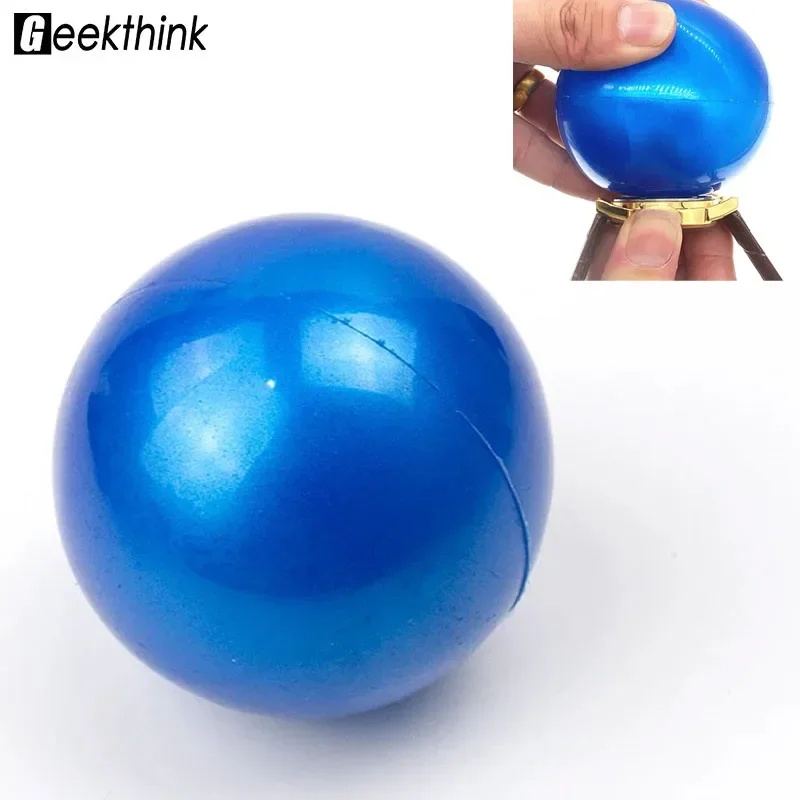
Kinematics & Limits: Friction balls conform to convex, polygonal, or notched profiles, making them particularly suited for display casebacks with sapphire crystals where metal jaws pose an unacceptable fracture risk. However, frictional torque transfer is limited by hand grip and surface tack. If an aged nitrile gasket has vulcanized or hardened in the thread path, breakout torque easily exceeds the surface coefficient of friction, requiring rigid mechanical engagement.
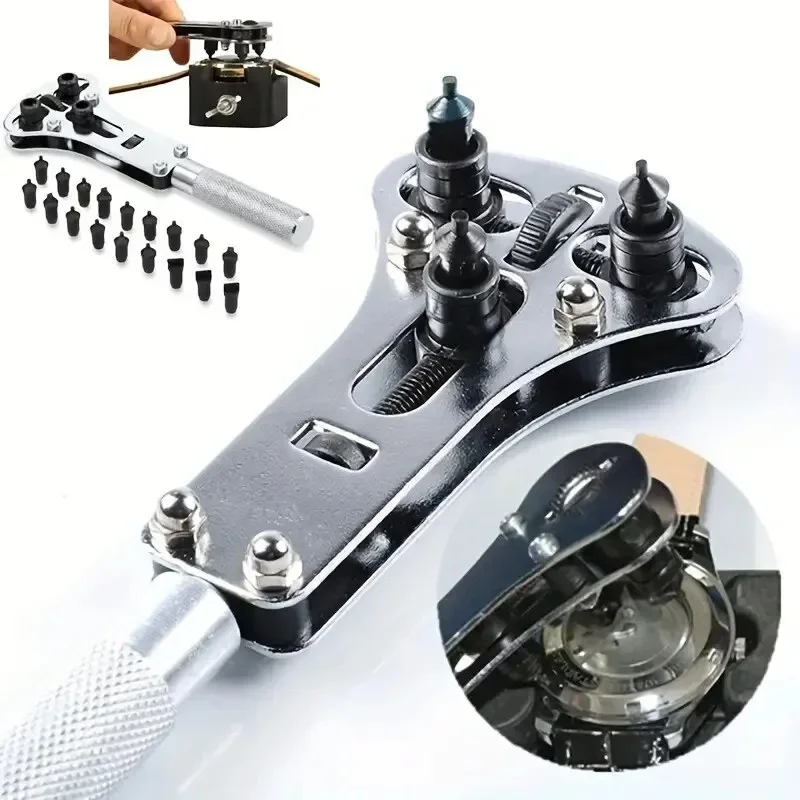
2. Pin Engagement for Threaded Backs: 2-Point vs. 3-Point Calipers
When breakout torque exceeds friction thresholds, the tool must seat directly into the perimeter notches machined into the caseback. The critical design variable here is tangential stability.
Two-Point Calipers
A two-point wrench acts on a single diametrical axis. Because it lacks lateral triangulation, the operator must apply continuous, perfectly centered axial force. Any minor pitch tilt or rotational wobble tilts the pins, leading to immediate slip and radial gouging across the case finish.
Three-Point (Jaxa Pattern)
The classic Jaxa arrangement uses three contact jaws set at roughly 120-degree intervals. This triangular geometric lock self-stabilizes the tool against lateral canting. It permits far greater leverage along the central handle without cam-out, distributing shear loads across three discrete case notches.

The two-pin caliper included in the multi-part kit above features an integral lead-screw adjustment. It is adequate for light-torque cases and small battery exchanges, particularly when bundled with a dedicated workholding vice. For seized, large-diameter, or factory-torqued diver casebacks, the wider radius and mechanical triangulation of a full Jaxa-style wrench become indispensable.
3. Interference Fits: Ground Wedge Mechanics
Snap-off case backs contain no threading. Attempting to rotate a snap case with a pin wrench will permanently ruin the case flange. Instead, the case relies on an interference lip—often identified by a minute recess or chamfered pry notch along the perimeter, typically adjacent to the lugs or between 9 and 11 o'clock.
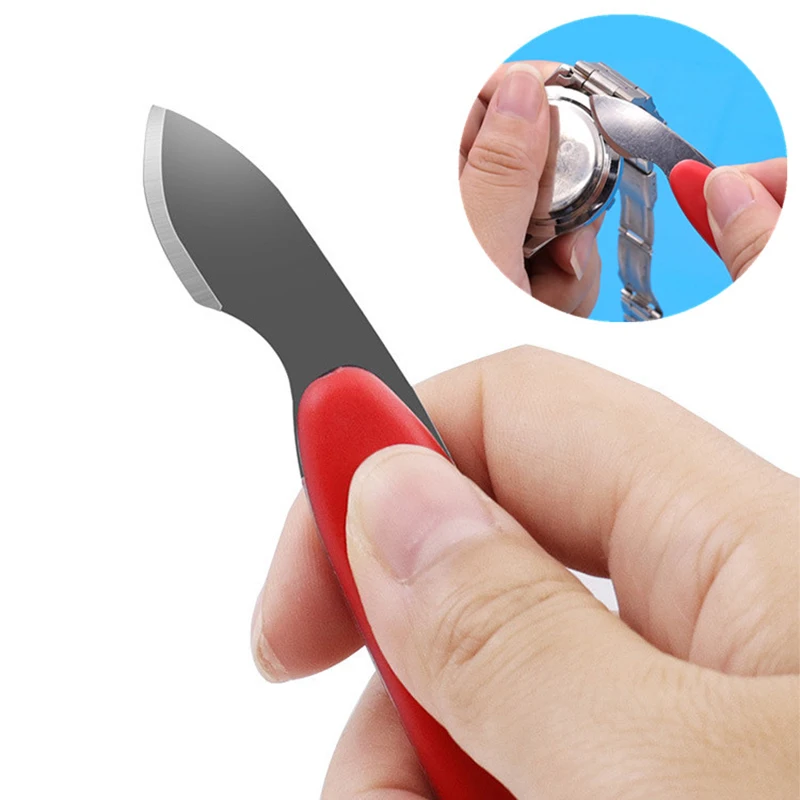
The Bevel Entry Vector: A proper watchmaker's pry knife is not an edged cutting instrument; it is a ground mechanical wedge. The flat underside sits flush against the case body, while the inclined upper bevel drives between the case lip and back. Force must be applied as a deliberate wrist rotation—twisting rather than levering upward—to pop the seal without driving the steel tip forward into the movement cavity, where fine copper coil windings are frequently positioned directly inside the rim.
Workholding: The Prerequisite for Controlled Torque
Holding a watch in the palm of your hand while applying rotational or shear torque with a metal tool is the primary cause of hand injuries and ruined cases. If the tool slips, the hand stabilizes the blade or pin at the cost of deep lacerations.
A dedicated case holder—such as the adjustable synthetic block with non-marring nylon pins found in multi-piece repair configurations—isolates the watch case. It immobilizes the chassis against counter-torque, keeps hands clear of slip vectors, and maintains the caseback parallel to the opening tool's rotational plane.
| Case Interface | Primary Tool | Mechanical Risk | Precautionary Step |
|---|---|---|---|
| Threaded (Low Torque / Crystal) | Rubber Friction Ball | Insufficient grip on stuck threads | Degrease caseback thoroughly before application |
| Threaded (Moderate Torque) | 2-Pin Adjustable Caliper | Yaw tilt / slip out of diametric axis | Use rigid movement holder; maintain downward axial load |
| Threaded (High Torque / Diver) | 3-Jaw Jaxa-Style Wrench | Mismatched pin profile shearing notches | Match bit geometry (flat/square/toothed) exactly to slot |
| Snap-Fit / Pressure Flange | Beveled Pry Knife | Over-penetration into movement / coil | Apply twisting torque across the bevel; avoid linear thrust |